Available today
Okinawa Churaumi Aquarium QR Fast Ticket
4.8
30 reviews
US$ 4.34

 Point Guide
All purchasers will receive a 7% discount coupon for Bic Camera Japan! The coupon can be downloaded from the purchase history page.

All purchasers will receive a discount coupon for Satudora! The coupon can be downloaded from the purchase history page.

All purchasers will receive a discount coupon for Don Quijote! The coupon can be downloaded from the purchase history page.

Japan's largest online accommodation expert.
5.0
박기*
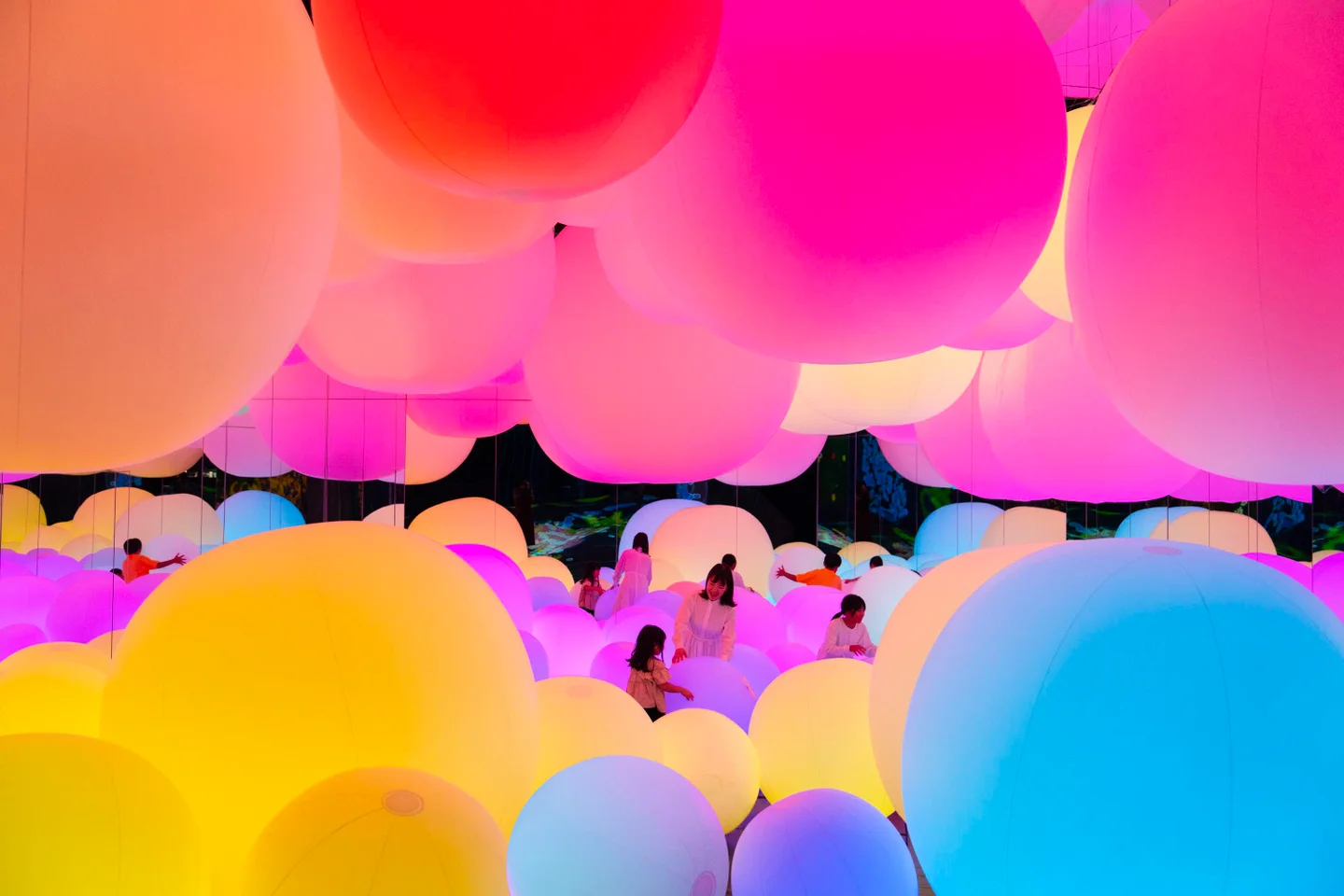
Although it is smaller in scale than the Tokyo teamLab, it was filled with only the best exhibits, making it easy and enjoyable to visit. In particular, the 'Light Ball Orchestra' section was really fun to roll the large balls and watch them change color.
teamLab Future Park Okinawa isn't just an exhibition to see, it's an exhibition to create together. Move your body to ride the slide, play hopscotch on the water, and watch the fish you colored swim in a giant aquarium. It's a space where children learn while playing and adults return to their childhood and laugh together, making it perfect for family trips or couple's itineraries. At the end, you can even make your own drawing into merchandise to take home as a travel souvenir.
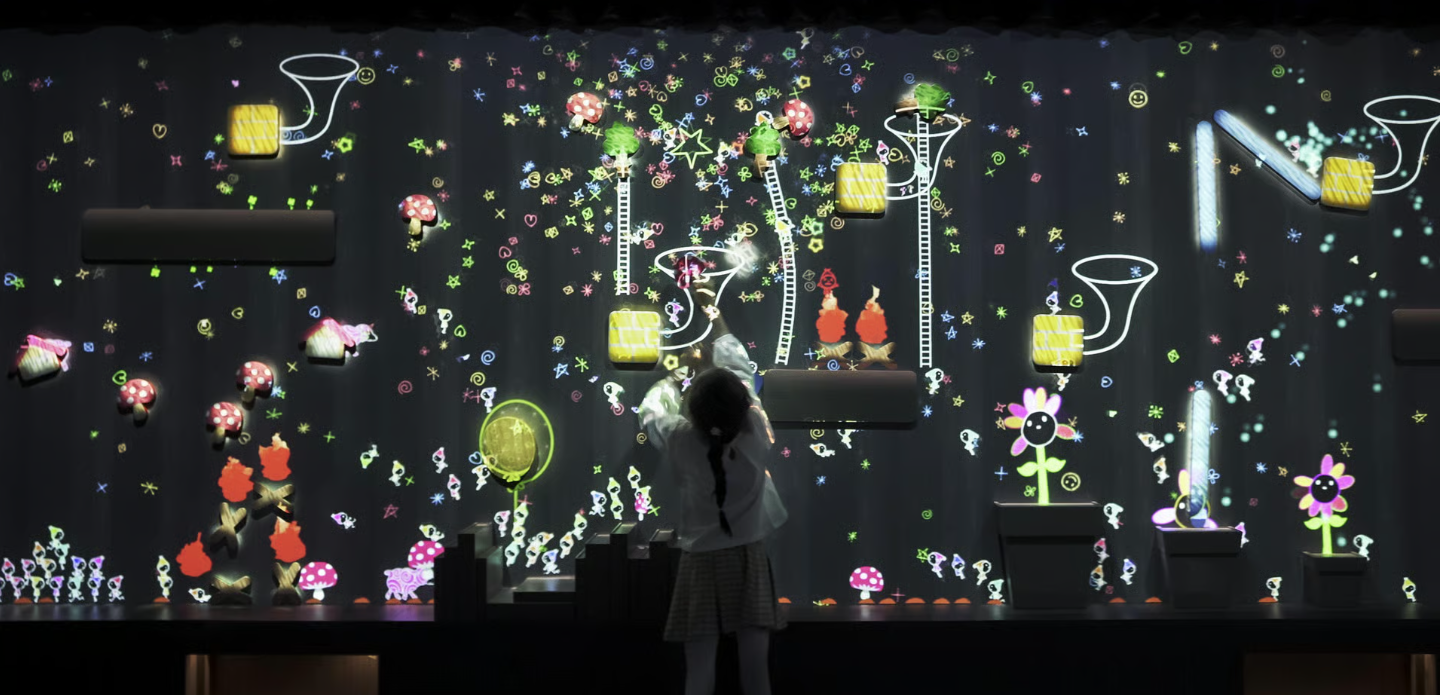
Where the fish I drew swim, teamLab Future Park Okinawa
teamLab in Okinawa is an interactive art playground that you can fully enjoy in the heart of Okinawa, regardless of whether it's raining or sunny. teamLab Future Park is centered around co-creation, and the more people participate simultaneously, the richer the work becomes. Instead of looking at the screen, you can directly run, touch, and move, changing the light, color, ecosystem, and flow of the entire space with your actions. In particular, the experience of turning a drawing on paper into a living thing in the exhibition hall and interacting with other people's works in one world is impressive. After enjoying the exhibition, you can continue to enjoy duty-free shopping in the same building, making the flow clean.
teamLab Main Exhibition Information
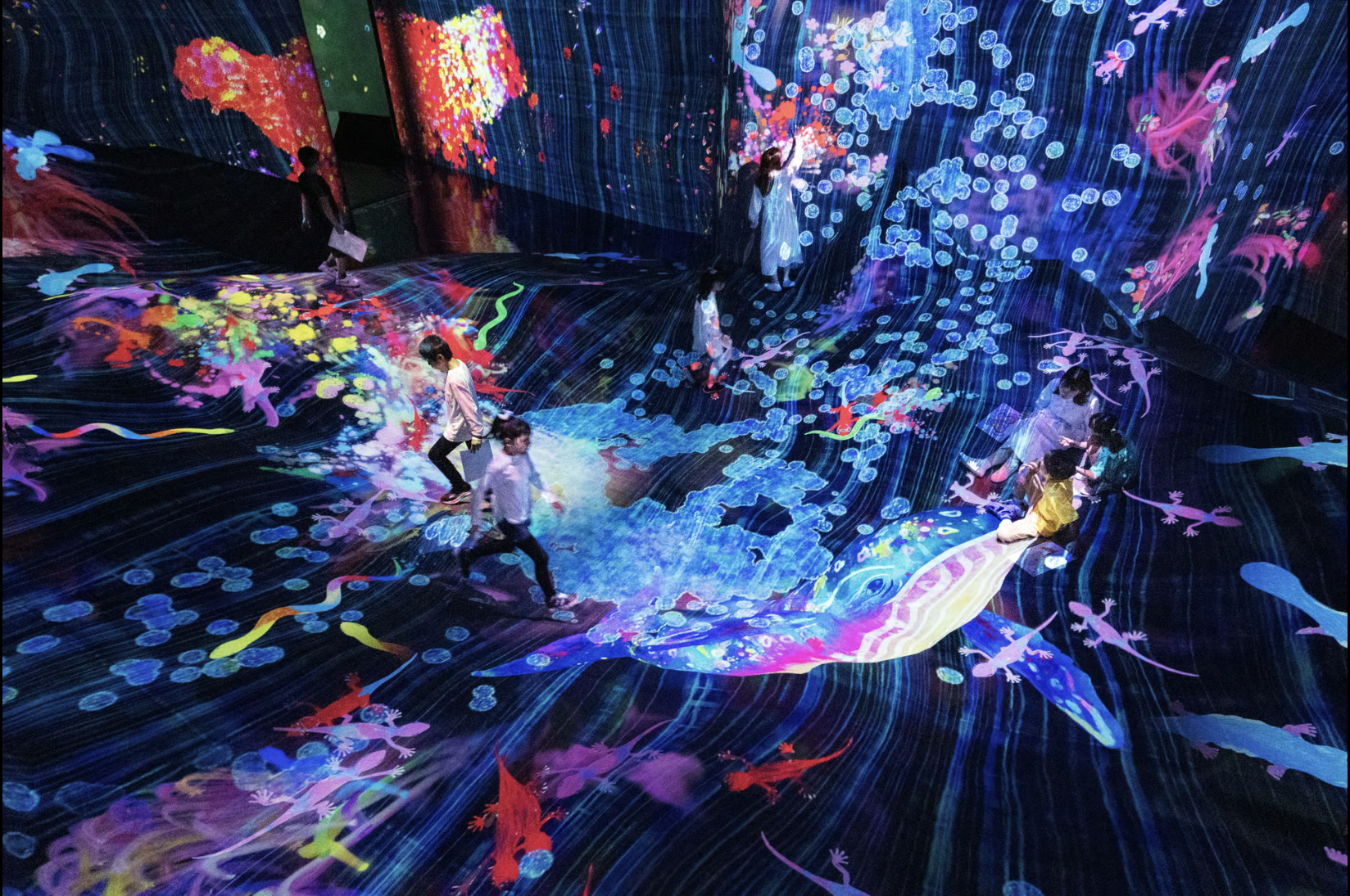
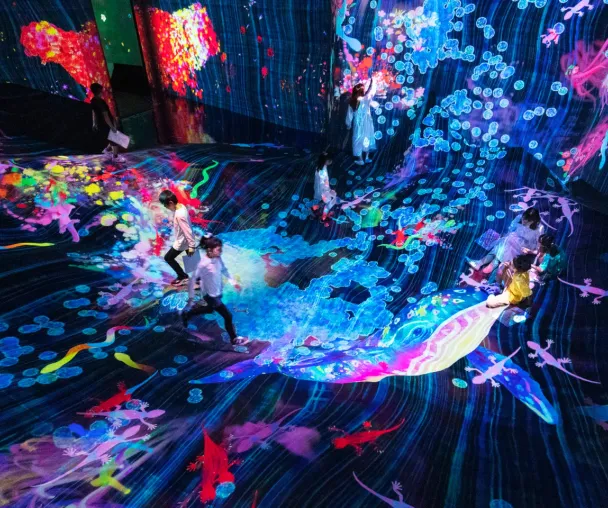
Work Name : Graffiti Nature in a Beating Valley - Symbiotic Lives, A Whole Year per Year, Red List
Credit (Shortened) : Graffiti Nature in a Beating Valley - Symbiotic Lives, A Whole Year per Year, Red List
Credit : teamLab, 2023-, Interactive Digital Installation, Sound: Hideaki Takahashi
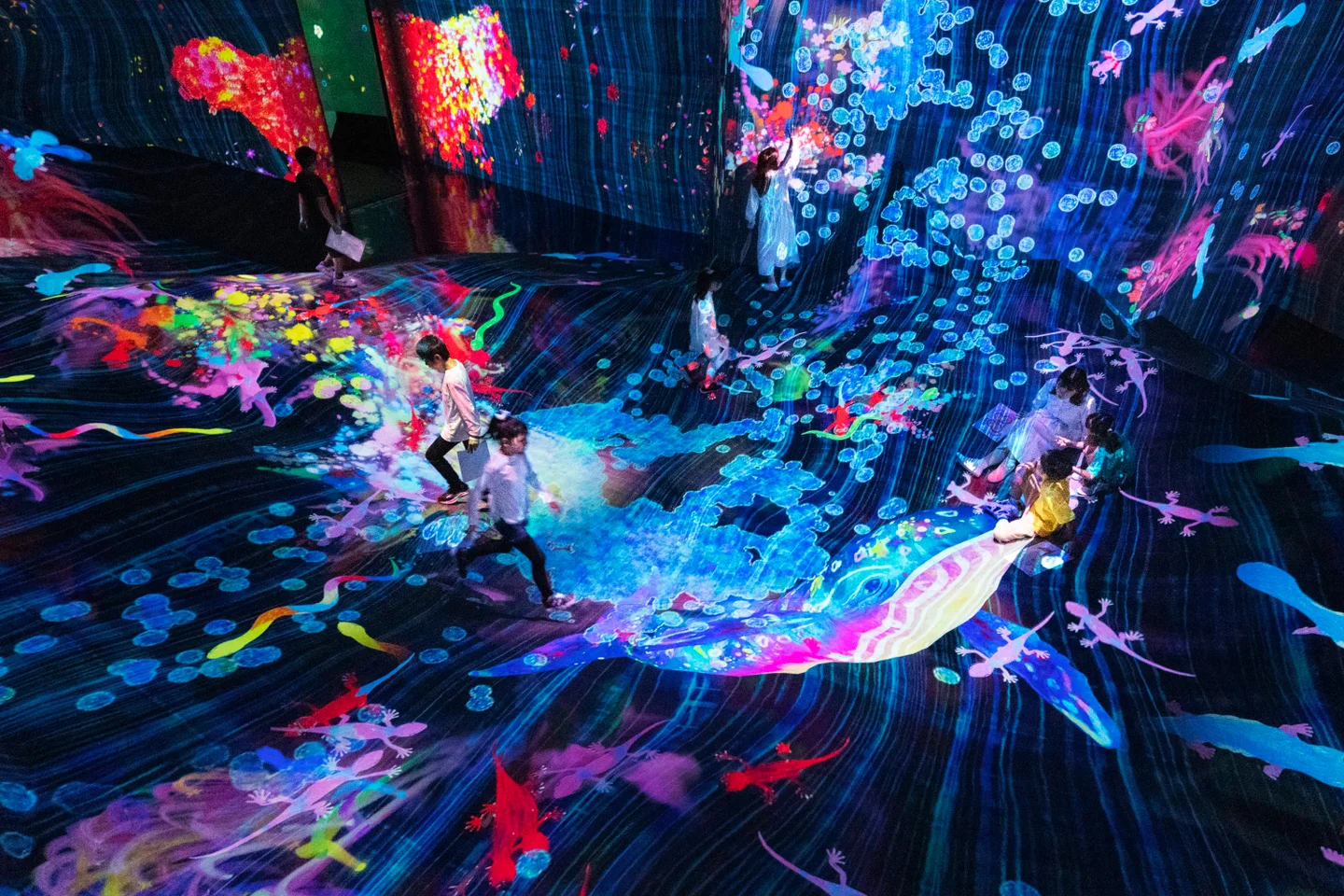
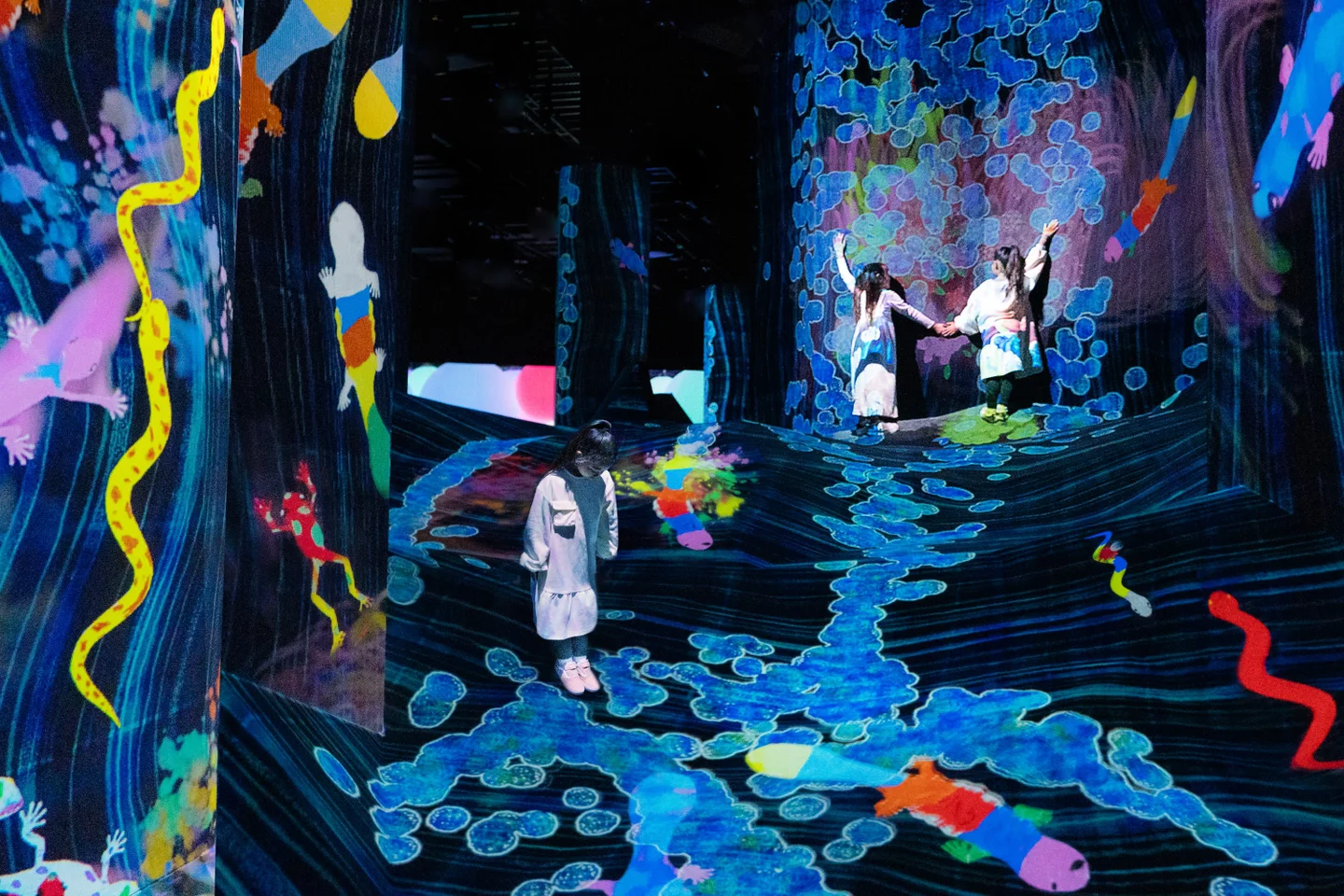
Beating Valley is a space where the three-dimensional terrain is constantly transformed and the curves undulate as the visual perception and the sensation felt by the body deviate.
Various creatures drawn by everyone live in Beating Valley. If you color the creature on the provided paper, the picture you drew will come to life and start moving in front of you. This place is connected to one ecosystem, so creatures eat each other and are eaten in a cycle. If the creature you draw eats other creatures, the number of individuals increases, but if it does not eat enough or is eaten by other creatures, it dies and disappears.
The salamander eats the snake, the snake eats the lizard, the lizard eats the frog, and the frog eats the butterfly. Each creature breeds along this food chain. Also, butterflies increase more where flowers grow.
If a person stops in one place, flowers bloom, but if people walk around and step on the flowers, the petals scatter. Salamanders also die if too many people step on them.
Creatures spread around the world, increasing and decreasing in number. The creature you drew may be increasing somewhere.
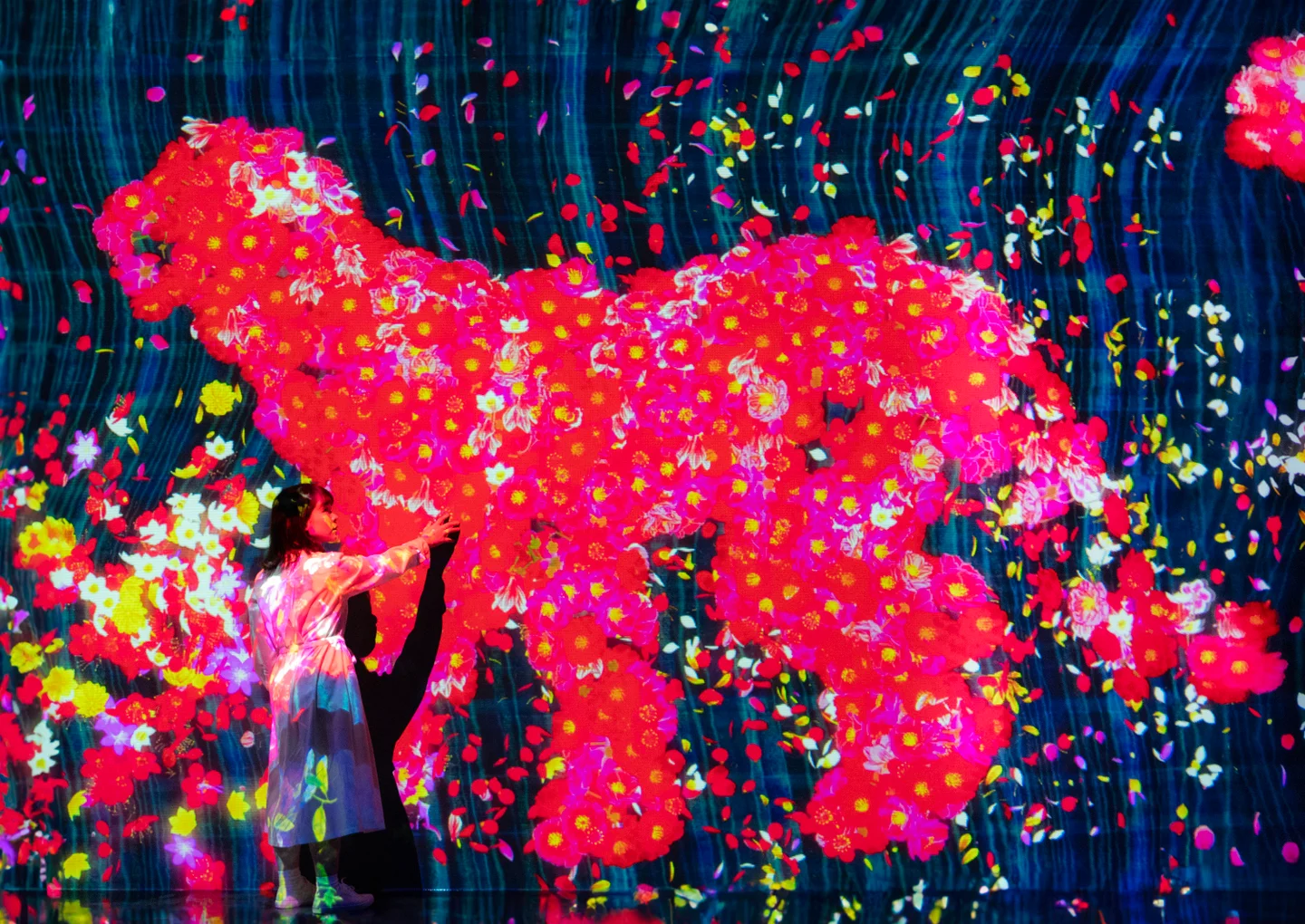
Sometimes this work is linked to and reacts with Animals of Flowers, Symbiotic Lives, and flowers corresponding to the current season in the real world grow and bloom from the creatures. When people step on animals made of flowers, the petals scatter.
The IUCN Red List is a database that summarizes the conservation status of species. This work features threatened and endangered species among the wildlife assessed in the Red List.
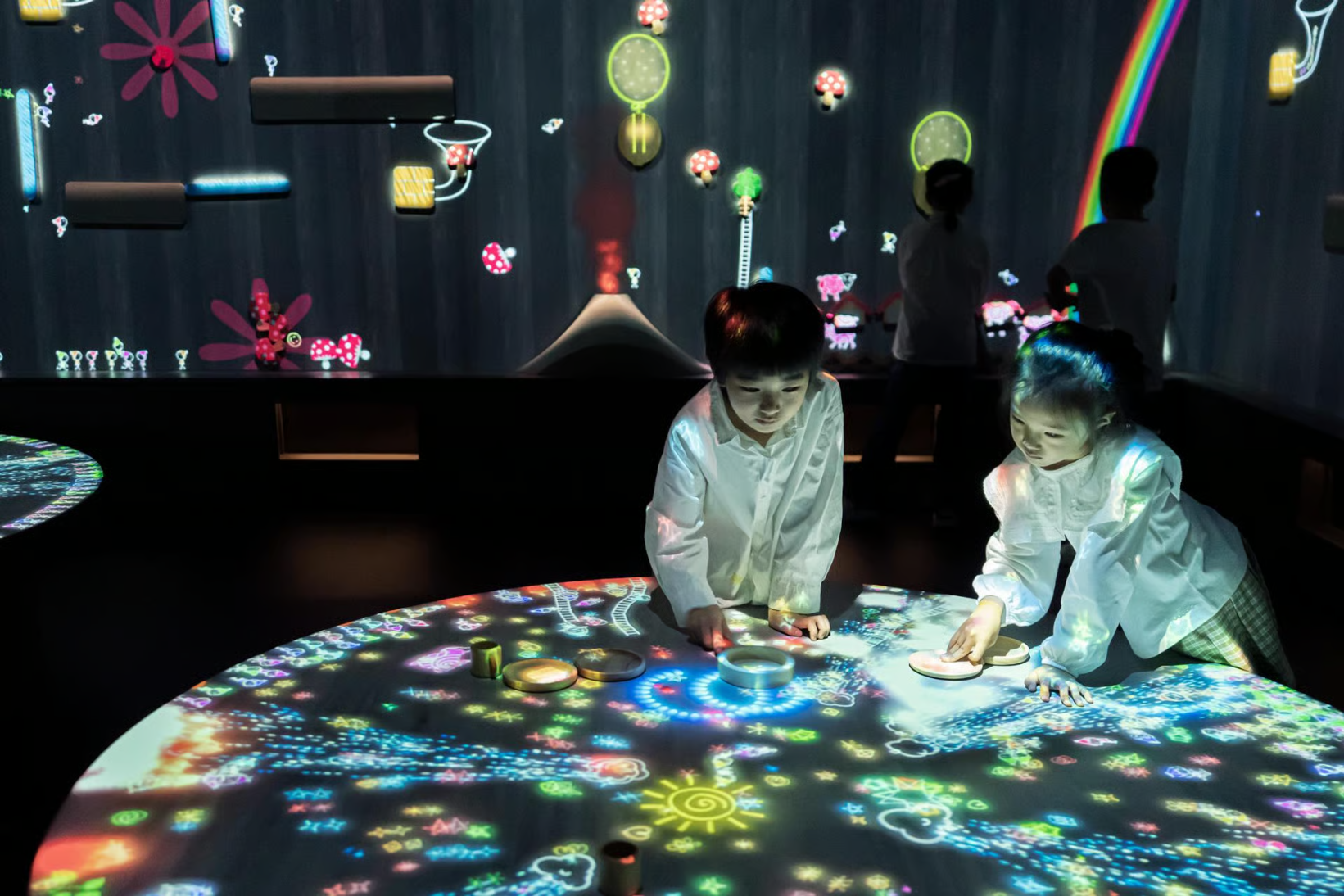
Work Name : A Table where Little People Live
Credit (Shortened) : A Table where Little People Live
Credit : teamLab, 2013-, Interactive Installation
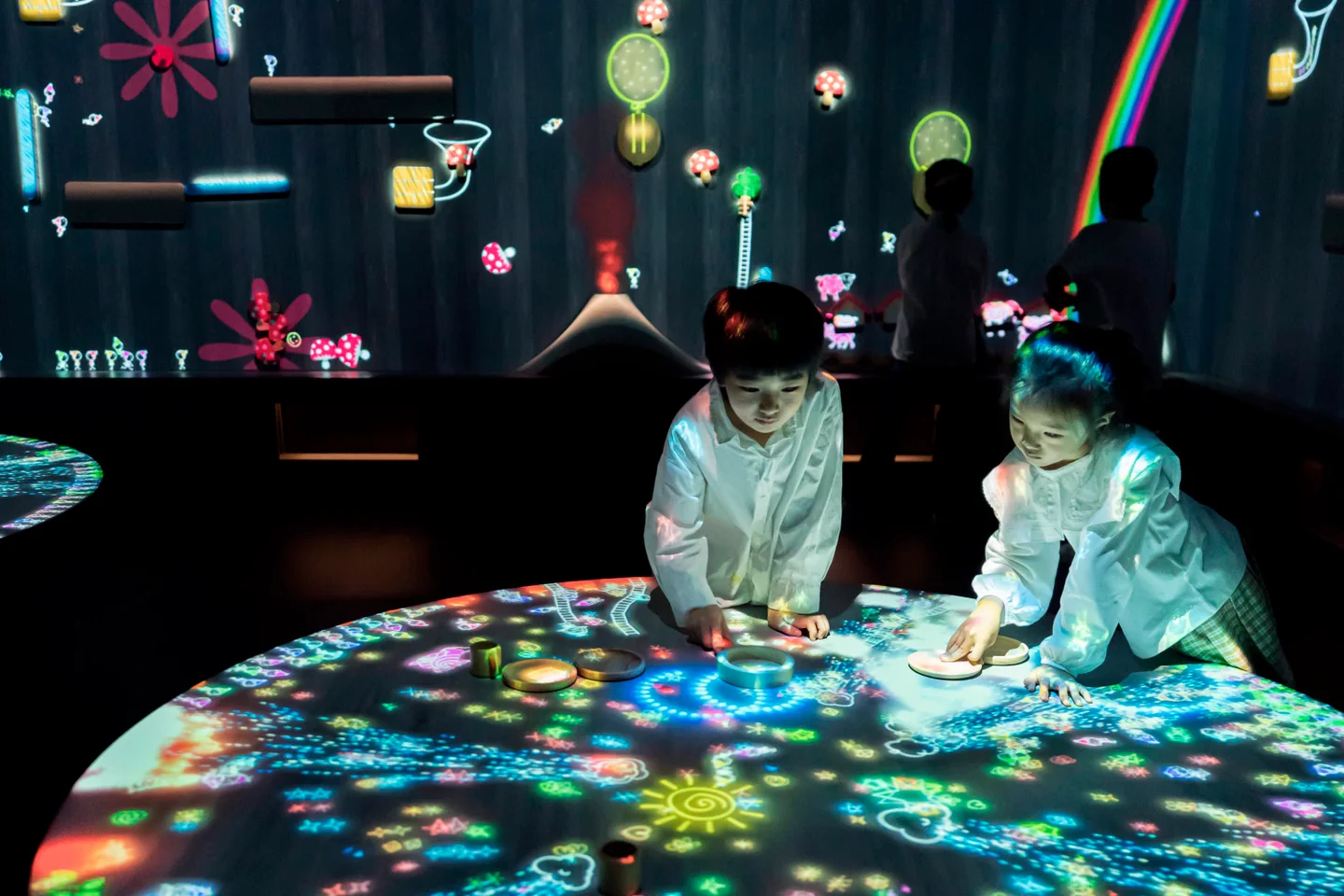
If you put something like a hand on the table, little people jump up onto it. Depending on the shape of the object placed on the table, the little people may slide, jump, or climb. Place several objects on the table and watch the little people's world transform into a completely new world.
Work Background
The Three Laws of Mechanics
The movement of objects in this world can be explained by three laws.
Law of Inertia
Unless a separate external force is applied to an object, the object remains in its current state.
For example, if you are on a stopped train and the train suddenly starts moving, you will feel pulled in the opposite direction of the train's direction because your body is trying to stay still. Conversely, if a running train suddenly stops, your body will lean in the direction the train was running because it is trying to continue moving forward.
Law of Motion
If a new external force is applied to an object, it will start moving in the direction the force was applied. The magnitude of the movement depends on the strength of the applied force and the weight of the object.
For example, more force is needed to push and move a heavy object. Also, if you bounce a heavy ball and a light ball with the same force, the light ball will bounce up faster.
Law of Action-Reaction
When you apply force to an object, a force of the same magnitude always returns in the opposite direction.
For example, if you push a wall, a force of the same magnitude as the force you pushed returns from the wall in the opposite direction.
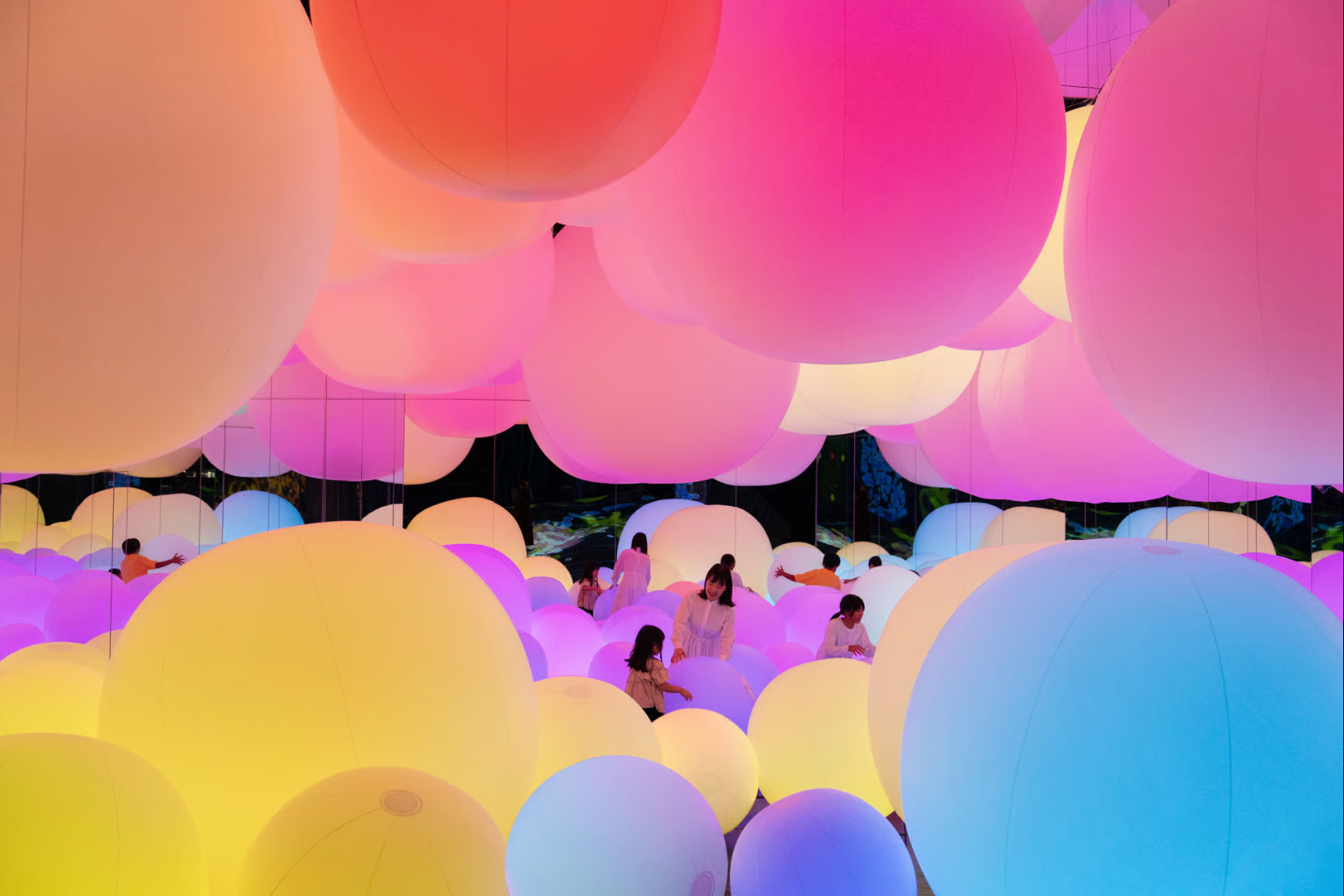
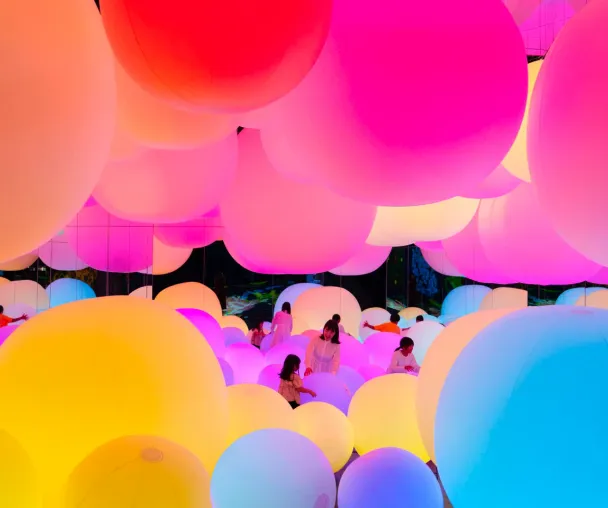
Work Name : Light Ball Orchestra
Credit (Shortened) : Light Ball Orchestra
Credit : teamLab, 2013–, Interactive Installation, Sound: teamLab
When you roll a light ball, the color and sound change. When several light balls come together, they become an orchestra.
The light balls hanging from the ceiling communicate with the light balls on the floor. When you touch one, the surrounding balls are affected in a chain reaction, changing the color of the entire space. When you roll the light ball in front of you, the color changes and the sound spreads.
In the same space, participants move their bodies and interact with light balls of different sizes, changing the color of the space and creating music in the process.
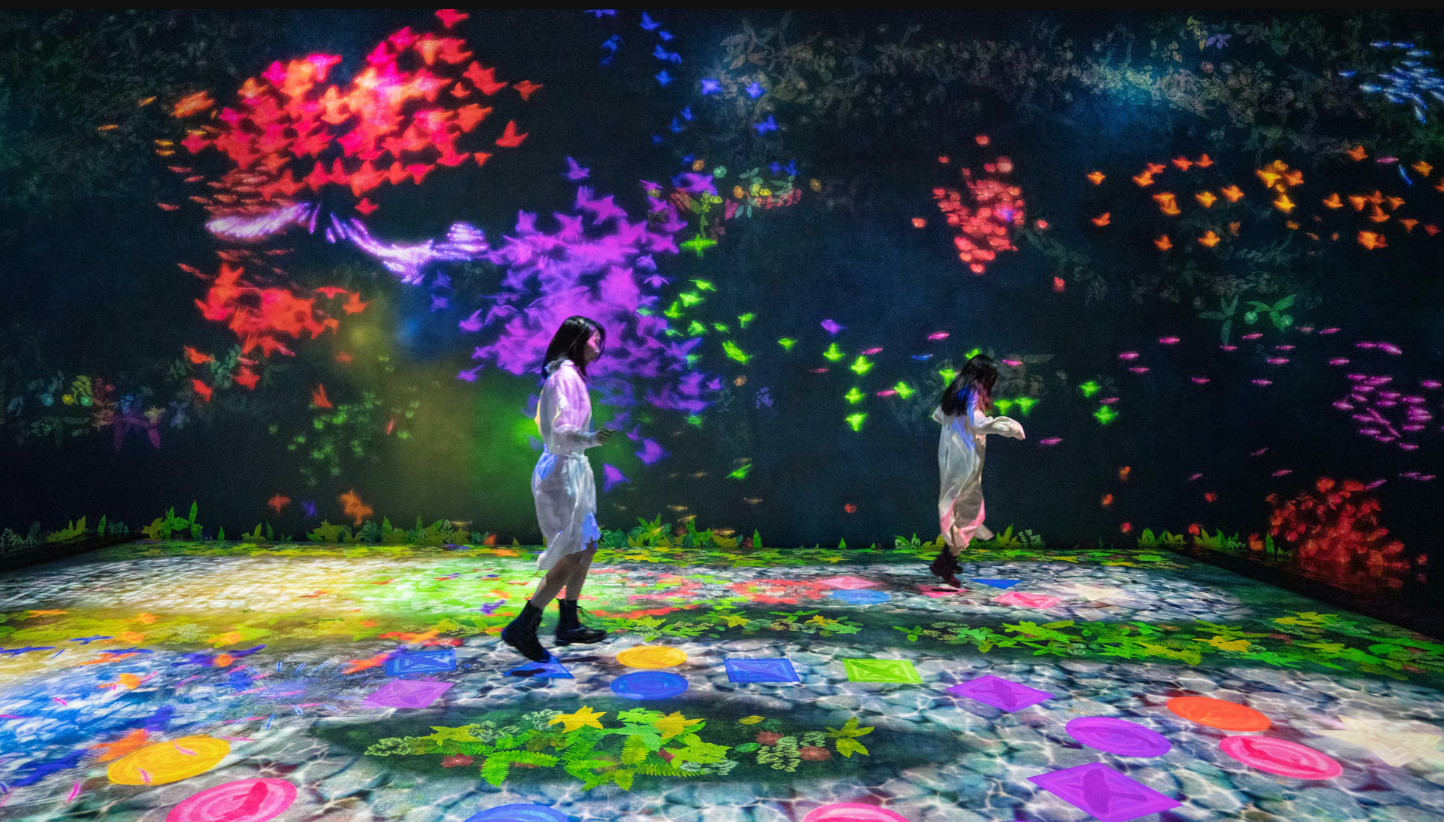
Work Name : Hopscotch for Geniuses: Bounce on the Water
Credit (Shortened) : Hopscotch for Geniuses: Bounce on the Water
Credit : teamLab, 2020-, Interactive Installation, Sound: Hideaki Takahashi
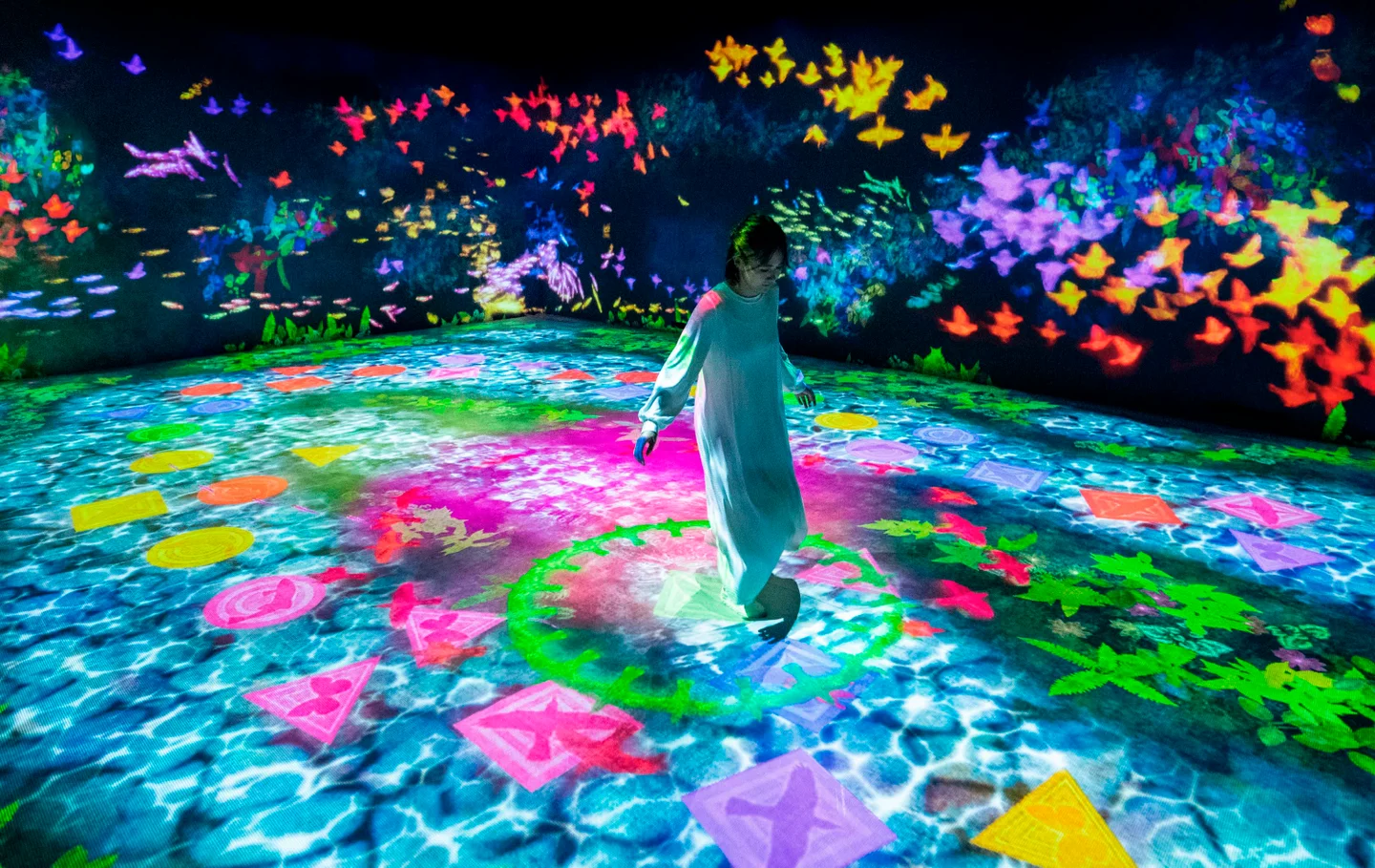
On the elastic water surface bouncing on the water, square, triangle, and circle shapes float on the water. Children jump on it and enjoy playing like hopscotch.
If you step on the same shape continuously, one fish, butterfly, or bird is created for each shape.
If you step on the same color continuously, that color spreads throughout the space.
The more you step on the same shape or the same color, the richer the world becomes.
If you touch the fish, butterflies, and birds moving along the wall with your hand, the animals disappear as if they are melting into the world.
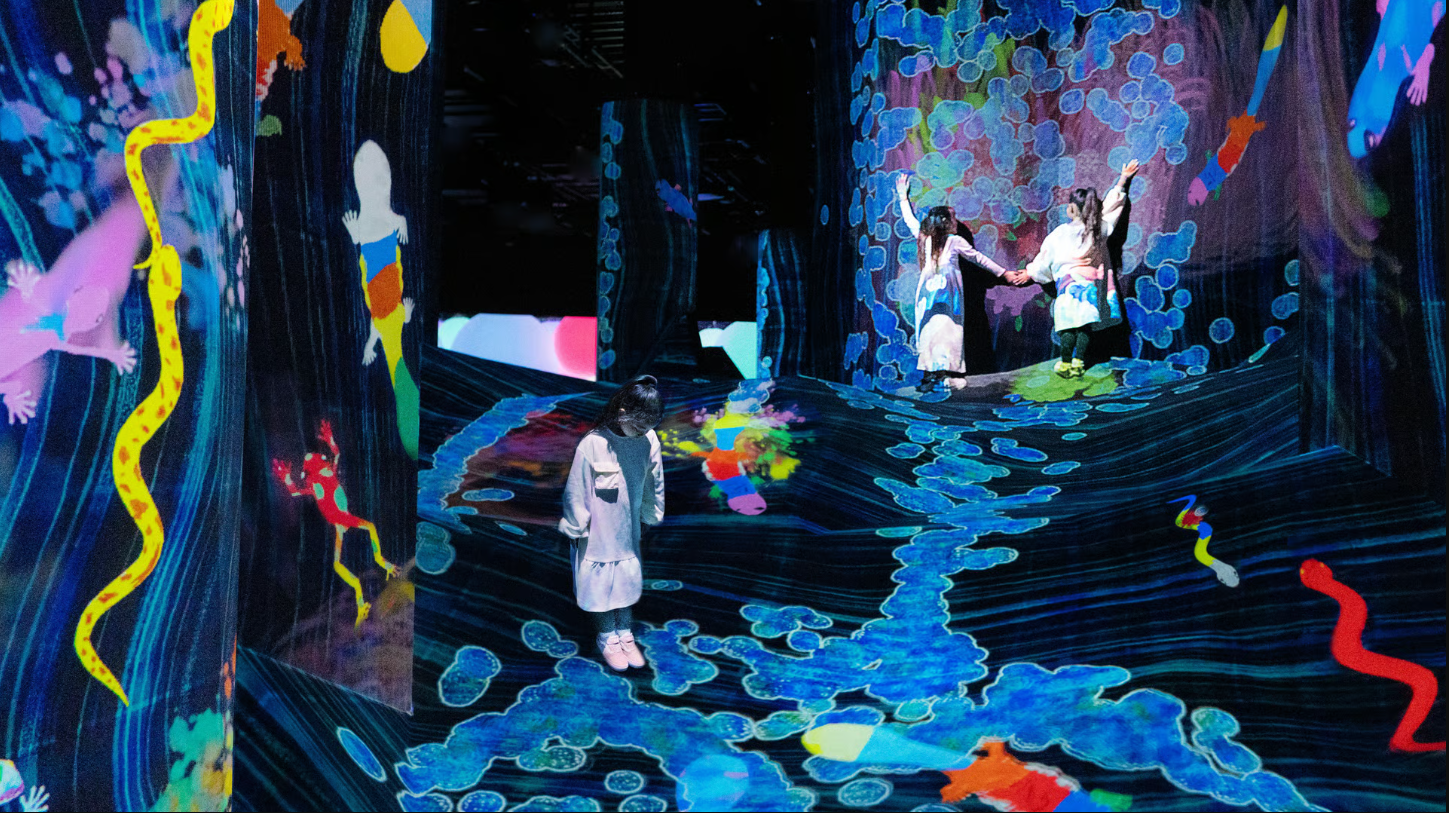
Work Name : Waterfall Droplets, Little Drops Cause Large Movement
Credit (Shortened) : Waterfall Droplets, Little Drops Cause Large Movement
Credit : teamLab, 2018-, Interactive Installation, Sound: Hideaki Takahashi
Numerous water droplets fall and flow along the terrain. If you bounce only one water droplet, it bounces like a ball, but if people gather water droplets using their whole body, they show the property of flowing like water. And when water droplets fall apart, they start bouncing like balls again.
A single water molecule cannot become a liquid. Many water molecules must come together for water to become a liquid. Water molecules have the property of attracting each other like magnets, so they stick together, resulting in the formation of water clusters, which are groups of water molecules. Water clusters are very short-lived and are believed to be constantly created and broken. Because the structure is very dynamic, water can change into various forms.
Most of the life and objects in this world exist as a whole, appearing as more than just the sum of the properties of the parts.
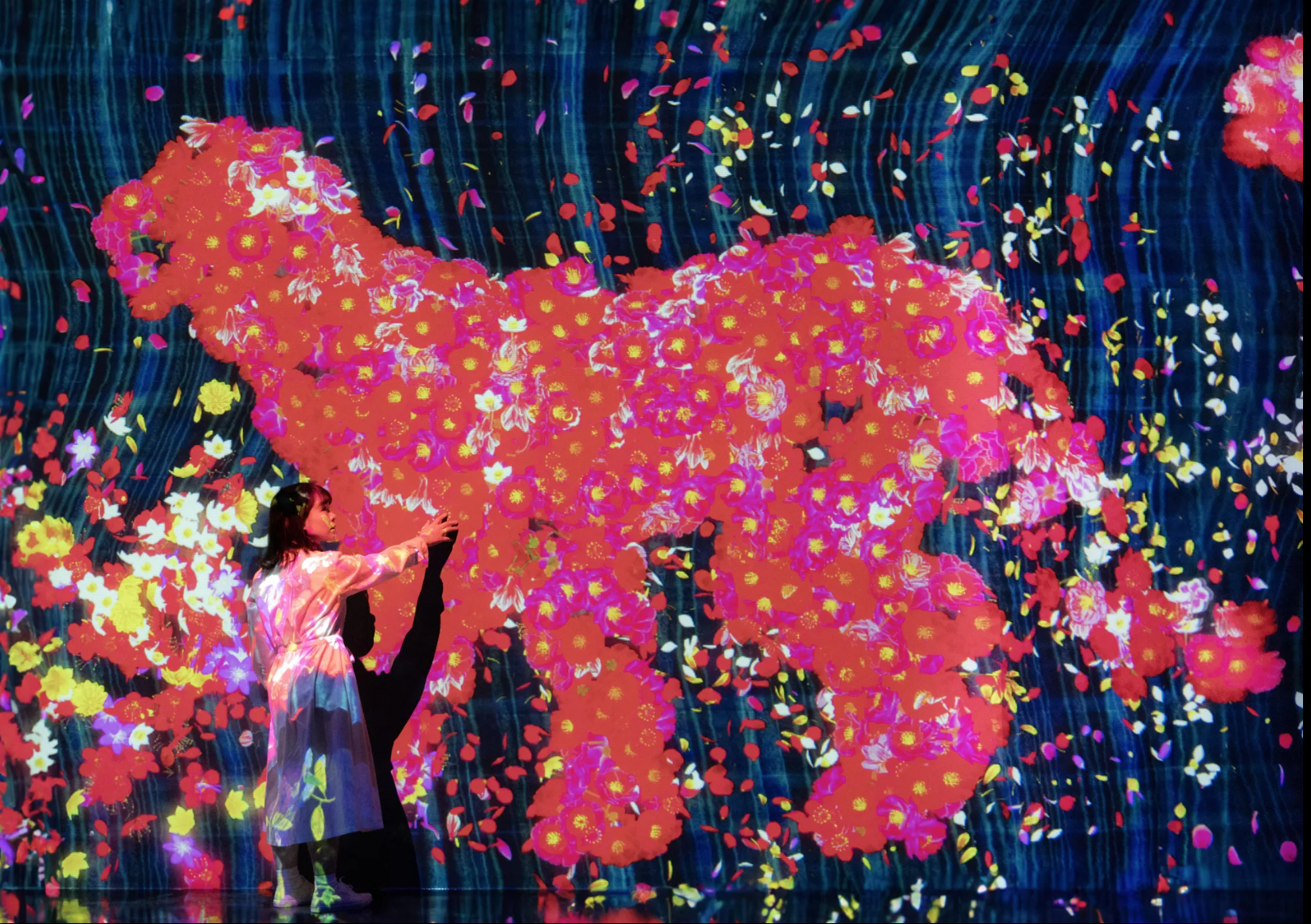
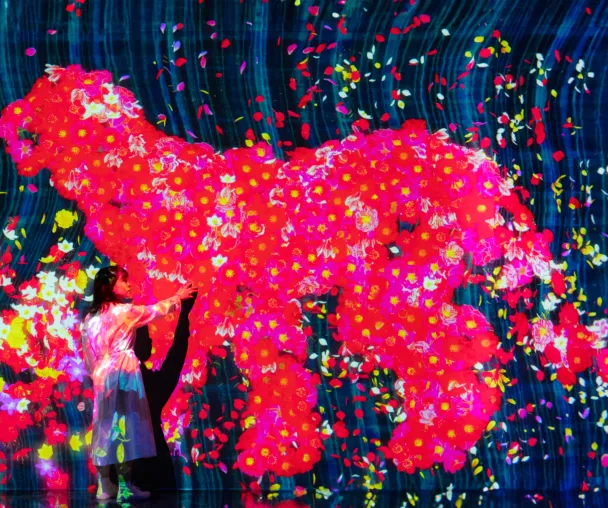
Work Name : Animals of Flowers, Symbiotic Lives - A Whole Year per Year
Credit (Shortened) : Animals of Flowers, Symbiotic Lives - A Whole Year per Year
Credit : teamLab, 2017-, Interactive Installation, Sound: Hideaki Takahashi
Animals are born from flowers and people. Although they cannot be controlled at will, they live together and are made of flowers blooming in the place where they were born. Because the flowers in the place of birth change over time, the flowers that make up the animal also change together. Flowers continue to create the shape of animals in a cycle of repeated birth and death.
When people touch the flowers of animals, the petals scatter. If you touch it too much, the animal dies and gradually fades away.
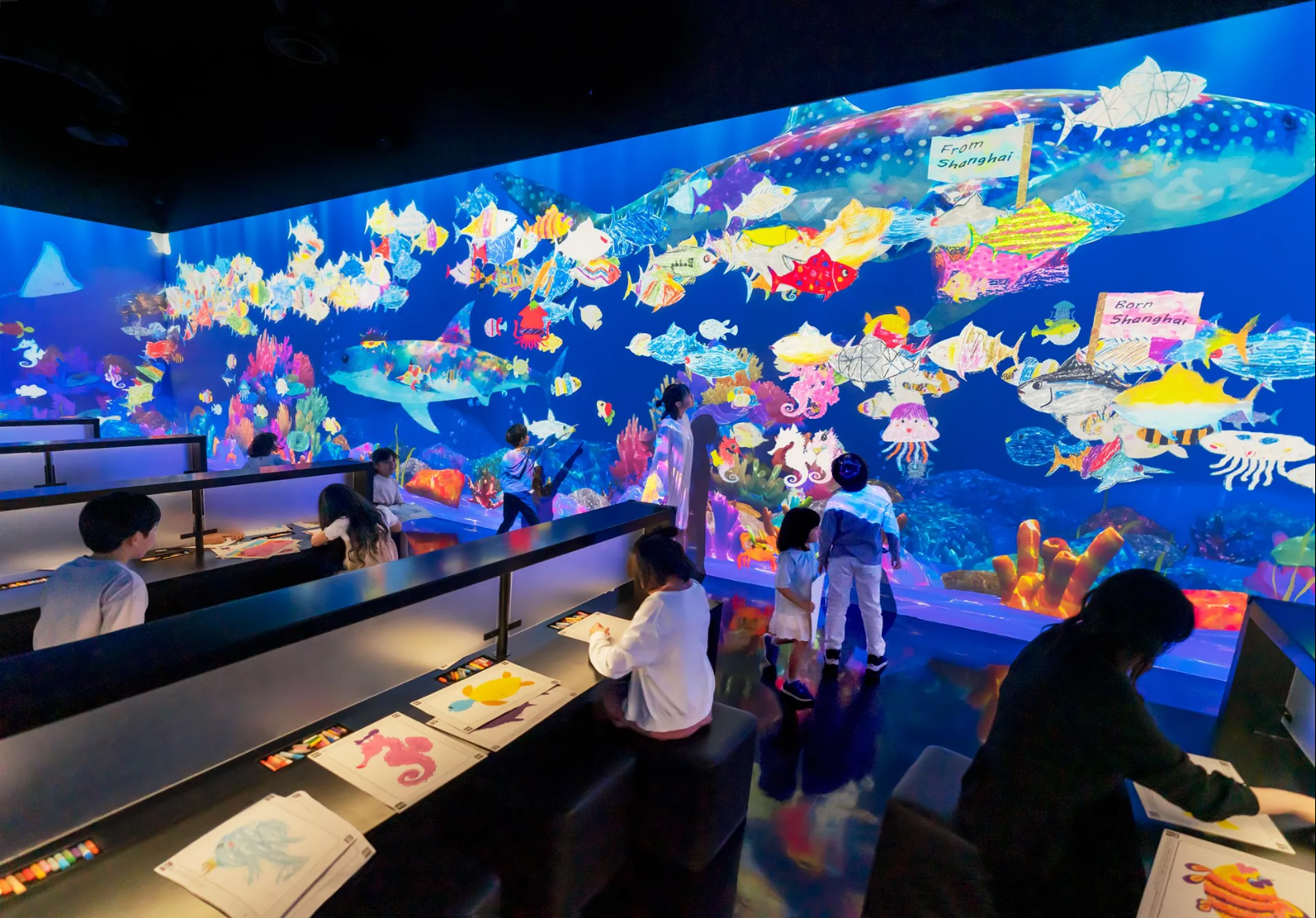
Work Name : Sketch Aquarium: Connected World
Credit (Shortened) : Sketch Aquarium: Connected World
Credit : teamLab, 2021-, Interactive Digital Installation, Sound: Hideaki Takahashi
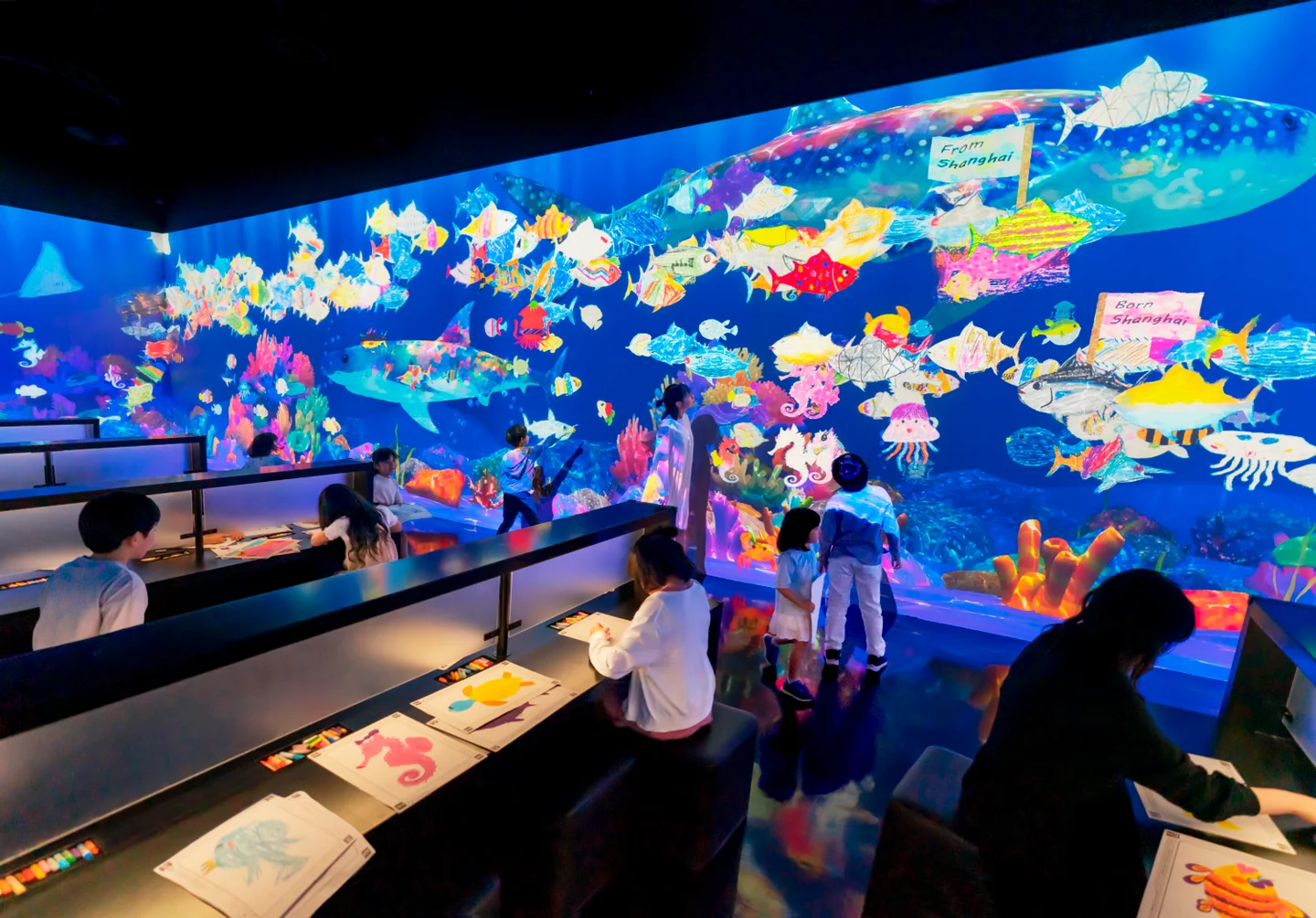
Various fish drawn by everyone swim around in this aquarium.
If you color the fish on the provided paper, the picture you drew comes to life and enters the giant aquarium in front of you. You can see the fish swimming in the same aquarium with the fish drawn by other people. If you touch the swimming fish with your hand, the fish swim away as if they are running away. You can also feed the fish by touching the feed bag.
Tuna transcends the physical boundaries of the work and swims out to the Sketch Aquarium and Sketch Ocean works in exhibitions around the world. Likewise, tuna drawn in other regions of the world may appear and swim in the Sketch Aquarium in front of you.
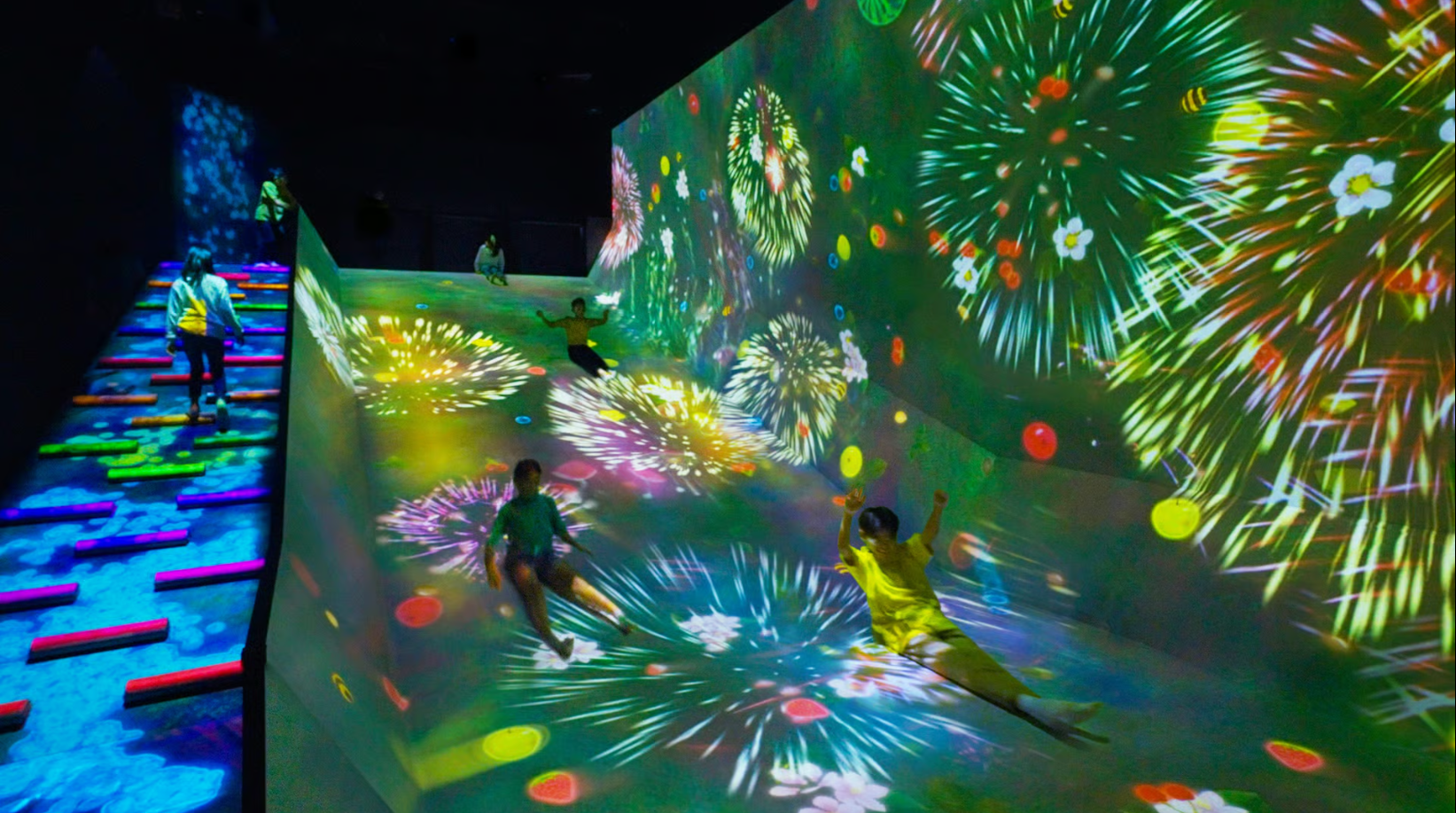
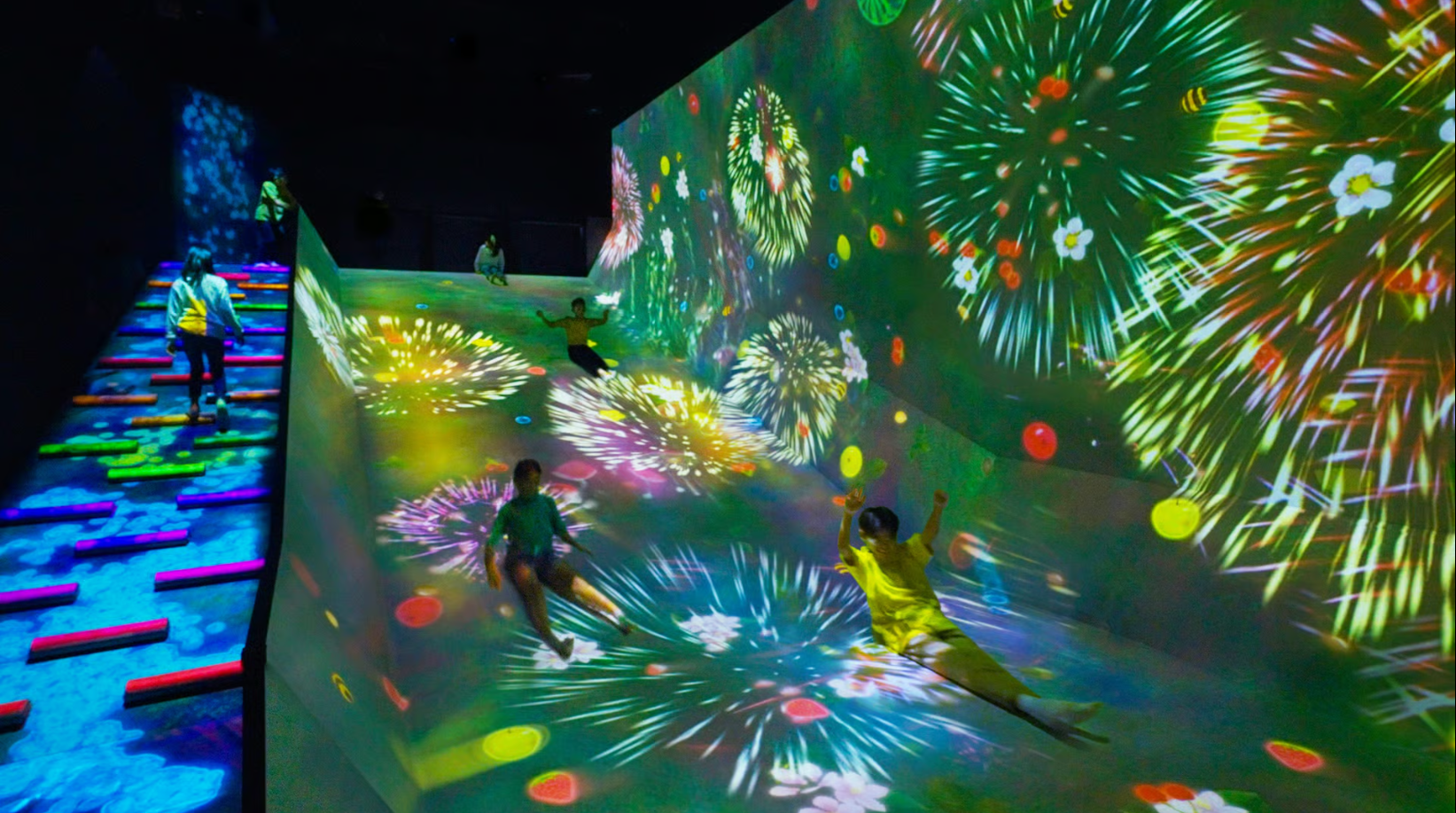
Work Name : Sliding through the Fruit Field
Credit (Shortened) : Sliding through the Fruit Field
Credit : teamLab, 2016-, Interactive Installation
This is a slide where fruit grows.
I become the sunlight and slide down the slope. When my body collides with water droplet balls and honeybee balls while going down, my energy is transferred to the balls and bounces in all directions. When the balls collide with the fruit, the fruit begins to grow.
The role of the ball varies depending on the color.
The light blue ball means water. When this ball touches a seed, it sprouts, flower buds form, and flowers bloom.
When the yellow honeybee ball touches the flower, pollination is achieved and the flower becomes a fruit.
When the fruit hits the ball, new seeds are sown, and the seeds lead to another life.
Work Background
The relationship between fruits and honeybees
Flowers bloom in plants that bear fruit. Flower nectar is food for many insects, including honeybees. And most fruit trees cannot produce fruit without insect pollination, and eventually it is difficult to leave seeds and reproduce. Insects such as honeybees and butterflies live with plants.
This phenomenon of different organisms cooperating and living together is called symbiosis.
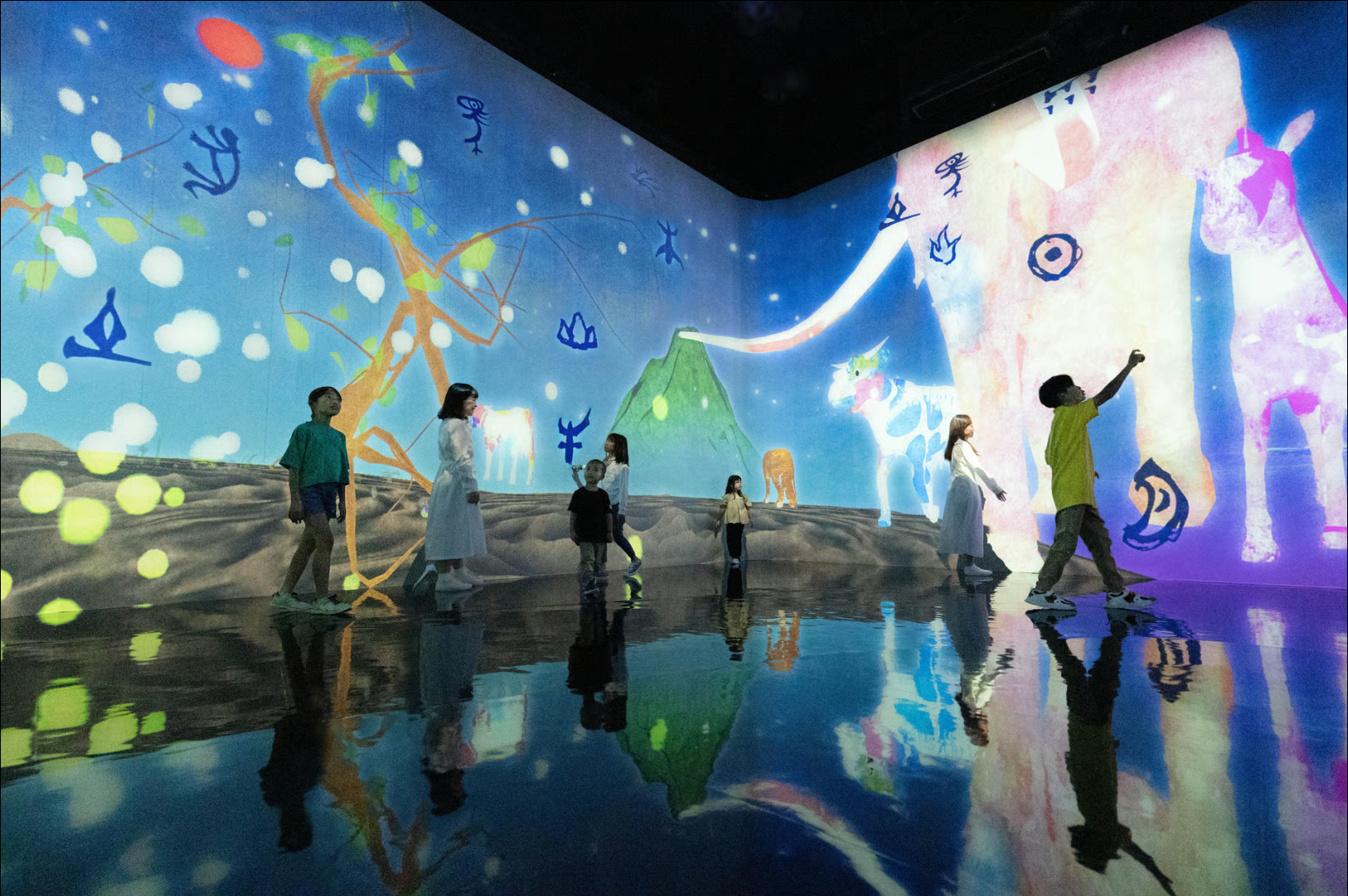
Work Name : Story of the Time when Gods were Everywhere
Credit (Shortened) : Story of the Time when Gods were Everywhere
Credit : Sisyu + teamLab, 2013-, Interactive Digital Installation, Calligraphy: Sisyu, Sound: Hideaki Takahashi
When people touch the letters representing mountains, trees, birds, etc. projected on the wall, the world of those letters appears and a story is born. The objects that appear from the symbols affect each other and are also affected by the actions of other people. For example, a bird may land on a tree, a sheep may run away from a dog, and a sheep may dance when a child approaches.
Work Background
The origin of Chinese characters
Since ancient times, words have been believed to contain spiritual power, that is, the spiritual power of language. However, because words disappear, that power could not remain within the words. According to the theory of Chinese scholar Shizuka Shirakawa, characters were born when people recorded words in pictographic form, like pictures, in order to sustain and make more effective the power they had put into words.
Chinese characters are believed to have been created around 1200 BC, during the Shang Dynasty. At that time, kings communicated with the gods through divination. Divination was performed in connection with important decisions of the dynasty, such as rituals, weather, war, harvest, and hunting. The beginning of oracle bone script was the recording of communication with the gods, that is, divination, in the form of pictures on turtle shells or animal bones, and this was the starting point of Chinese characters.
How To UseAddress :
teamLab Future Park Okinawa
teamLab Future Park, Japan, 〒900-0006 Okinawa, Naha, Omoromachi, 4 Chome−1 3F
View in Google Maps
Operating Hours :
10:00 AM to 8:00 PM (Last admission is 7:00 PM)
How to Get There :
By train: Right next to Yui Rail Omoromachi Station. It takes about 19 minutes from Naha Airport by Yui Rail.
By car: About 30 minutes by car from Naha Airport. Parking is available for up to 180 cars.
※ All usage conditions are subject to the information stated on the voucher. Refunds or compensation will not be provided if you are unable to use the service due to failure to check the information.※ All usage conditions are subject to the information stated on the voucher. Refunds or compensation will not be provided if you are unable to use the service due to failure to check the information.

642-3 Kabira, Ishigaki, Okinawa 907-0453 일본
What to Remember Point Guide
![[Special Deal] Okinawa Southern Bus Tour (Cape Chinen, Miibaru Beach, Okinawa World, Senagajima Island)](https://d2mgzmtdeipcjp.cloudfront.net/files/good/2025/04/15/17447236301769.jpg?s=656x372&t=outside)




![[Exclusive Discount] Chatan Departure: Okinawa Kerama Islands 3 Best Snorkeling Spots Tour](https://d2mgzmtdeipcjp.cloudfront.net/files/good/2019/12/30/15776840626626.png?s=656x372&t=outside)